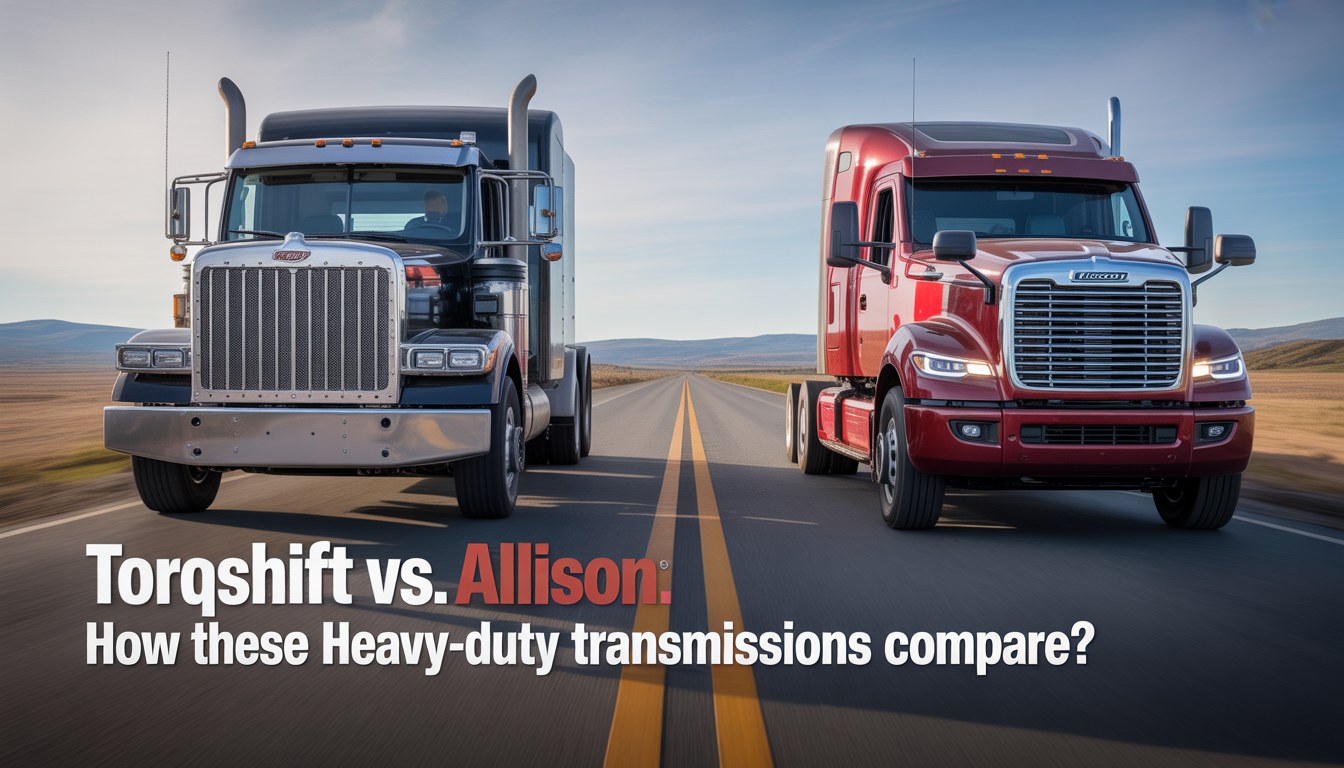
Battle of the Heavyweights: TorqShift vs. Allison Transmissions
As heavy-duty trucks become the backbone of the towing and hauling industry, two names reign supreme: Ford’s TorqShift and GM’s Allison transmissions. With the latest models pushing the boundaries of performance, how do these heavyweights stack up? Let’s dive into their evolution, specifications, and reliability concerns.
Transmission Evolution: A Brief History
The journey of these transmissions began in the early 2000s. Ford launched the TorqShift transmission in 2003, starting with the five-speed 5R110 in its Super Duty pickups. This was followed by the six-speed 6R140 in 2011, and most recently, the 10-speed 10R140 debuted in 2020, enhancing towing capabilities for the 6.7L Power Stroke diesel and 7.3L gas V8 engines. For 2025, the 10R140 is standard across various Super Duty models, while a lighter-duty variant, the TorqShift G, is available for the 6.8L gas engine.
On the GM side, the Allison transmission found its footing in 2001 with the five-speed A1000, designed to pair with the Duramax diesel in HD pickups like the Chevrolet Silverado and GMC Sierra. By 2020, the 10-speed Allison 10L1000 became available across the board, and by 2024-2025, it will be standard in all GM HD models. Notably, after the GM-Allison partnership ended, GM has continued to produce these transmissions in-house.
Internal Design: Strength vs. Weakness
Digging deeper into the mechanics, the TorqShift 10R140 boasts several advantages over the Allison 10L1000:
- Larger Fluid Filter: The TorqShift’s filter is approximately twice the size of the Allison’s, ensuring better fluid management.
- Bigger Pump Gear: A more substantial pump gear in the TorqShift enhances fluid flow and efficiency.
- Anodized Drums: The TorqShift features anodized drums, increasing durability compared to Allison’s non-anodized design.
- Stronger Clutch Packs: With beefier F-clutch teeth and higher friction material, TorqShift’s clutch packs are designed for heavy-duty use.
These design elements lead to a longer service interval for the TorqShift, rated at 150,000 miles versus Allison’s 45,000 miles.
Performance and Towing Capacity
When it comes to performance, both transmissions are formidable, but the TorqShift has the edge for heavy towing:
- Lower Gear Ratios: The TorqShift’s first gear ratio is 4.615:1, compared to Allison’s 4.54:1, making it better suited for towing.
- Towing Capacity: The Ford 6.7L Power Stroke diesel can generate up to 1,200 lb-ft of torque, supporting a maximum tow rating of 40,000 lbs. In contrast, the GM 6.6L Duramax peaks at 975 lb-ft and a max tow rating of 36,000 lbs.
While both transmissions are capable, the TorqShift is particularly tailored for maximum towing performance, making it the go-to choice for heavy-duty applications.
Reliability Concerns: A Closer Look
Despite their strengths, each transmission has notable reliability issues. The TorqShift 10R140 has faced challenges, particularly with planetary needle bearing failures and CDF drum bushing slippage, leading to pressure problems and rough shifts. Recent NHTSA reports noted these issues in certain 2020 Super Duty models.
Meanwhile, the Allison 10L1000 has a reputation for clutch wear, especially in tuned Duramax engines. The thinner friction material and aluminum pistons are often cited as weak points, particularly under heavy loads or when performance enhancements are applied.
Which Transmission is Right for You?
If towing is your primary concern, the TorqShift 10R140 stands out as the better choice, thanks to its robust construction and superior towing capabilities. However, for balanced heavy-duty usage, either transmission could suffice, depending on your truck’s specific needs and ecosystem.
As the battle of the heavy-duty transmissions continues, both Ford and GM are committed to refining their offerings, ensuring that truck enthusiasts and industry professionals alike have the tools they need for heavy hauling.
Leave a Reply