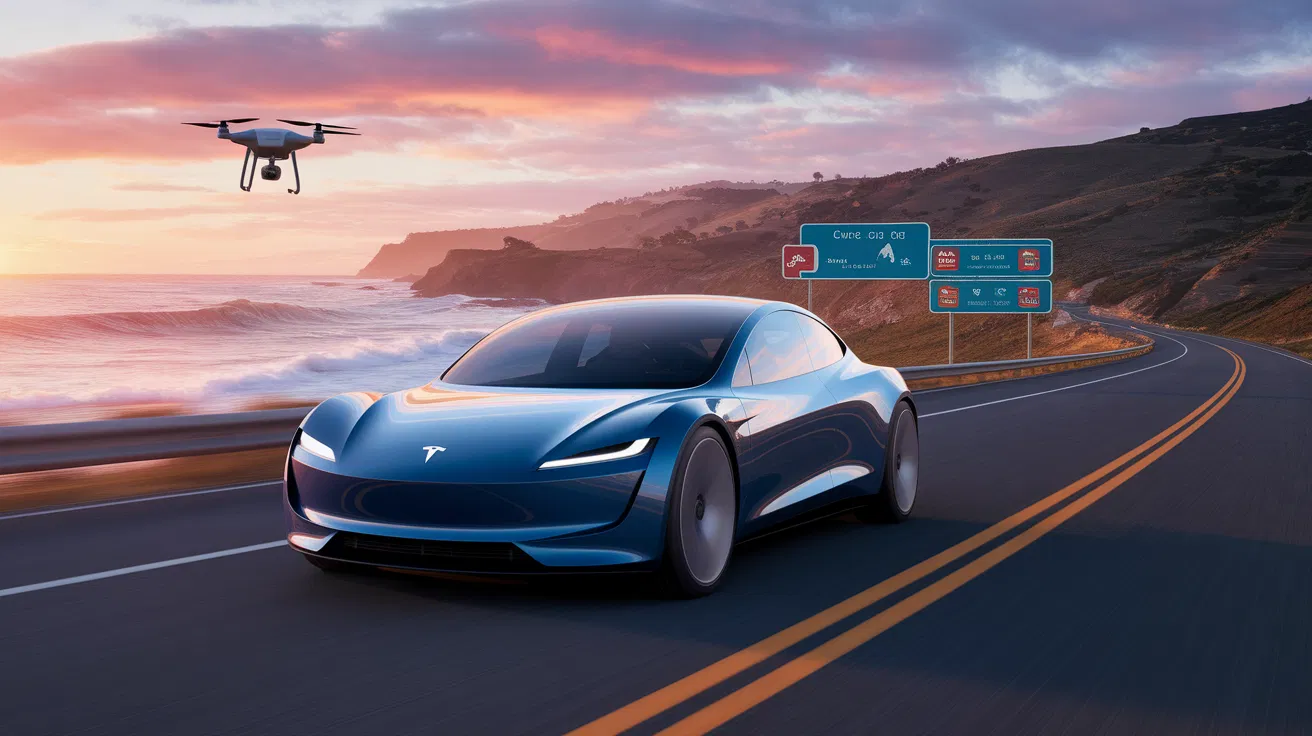
Tesla’s Fsd Breakthrough: First Coast-To-Coast Drive With Zero Interventions
The Historic Journey
In a remarkable milestone for autonomous driving technology, Tesla owner David Moss successfully completed a coast-to-coast journey from Los Angeles to Myrtle Beach, covering 2,732.4 miles in just 2 days and 20 hours. Utilizing the Full Self-Driving (FSD) Supervised version 14.2.1.25 on his 2025 Model 3, Moss’s drive was notable for achieving zero interventions, including no disengagements for parking or Supercharging stops. Prior to this trip, his vehicle logged over 10,638.8 consecutive miles using FSD, representing one of the highest usage rates in community trackers.
Inside the Technology
The FSD Supervised technology operates at SAE Level 2, requiring constant human oversight despite its advanced capabilities. The latest version, 14.2, introduced rapid weekly updates that improved performance in complex driving scenarios such as parking and navigating through multiple states. Moss’s Model 3, equipped with AI4 hardware, demonstrated these advancements effectively throughout the entire trip.
Community and Industry Reactions
This achievement has not gone unnoticed within the Tesla community and the automotive industry. Tesla executives, including VP of AI Software Ashok Elluswamy, celebrated the event as the “world’s first fully autonomous coast-to-coast drive.” Enthusiasts and industry insiders alike took to social media, expressing their excitement and validating Moss’s trip through community FSD databases. The response highlights a growing optimism around the potential of FSD technology, despite its current supervised status.
The Bigger Picture
Elon Musk’s ambitions for Tesla’s autonomous capabilities date back to 2016, when he first predicted a coast-to-coast drive by the end of 2017. While many of his timelines have been criticized as overly optimistic, Moss’s successful journey provides a glimmer of progress toward these goals. However, it also raises questions about the future of regulatory approval and the reliability of FSD as it continues to evolve.
Moss’s drive is a significant step in demonstrating the technology’s viability in real-world conditions across 24 states, albeit still under human supervision. This contrasts sharply with past attempts that ended in disengagements or crashes, underscoring the challenges Tesla faces in scaling up to unsupervised operations amidst a rapidly changing technological landscape.
As FSD technology continues to improve, the industry watches closely. Will this achievement propel Tesla closer to full autonomy, or will it remain a supervised endeavor? Only time will tell, but for now, the community celebrates a pivotal moment in the journey toward self-driving cars.
Leave a Reply